
Directional self-assembly of organic semi-type core-shell microwires for programmable visible-to-near-infrared waveguiding conversion
Bin Wu1,2, Ming-Peng Zhuo2,3(卓明鹏)*, Ying-Li Shi4, Lin-Feng Gu1, Yu-Dong Zhao1, Yang Su1, Yuan-Yuan Li2,3, Hang Lu2,3, Wei-Feng Li1,Zuo-Shan Wang1(王作山)*, Xue-Dong Wang2(王雪东)*
1College of Chemistry, Chemical Engineering and Materials Science, Soochow University, Suzhou, Jiangsu 215123, P.R. China
2Institute of Functional Nano & Soft Materials (FUNSOM), Jiangsu Key Laboratory for Carbon-Based Functional Materials & Devices, Soochow University, Suzhou, Jiangsu 215123, P.R. China
3National Engineering Laboratory for Modern Silk, College of Textile and Clothing Engineering, Soochow University, Suzhou, Jiangsu 215123, P.R. China
4Department of Electrical and Electronic Engineering, Xi’an Jiaotong-Liverpool University, Suzhou, Jiangsu 215123, P.R. China
Chem 2025,11, 102497
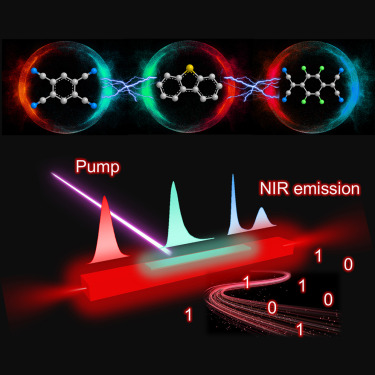
Abstract:Organic topological structures integrating multi-color emission and waveguide for optical interconnects are of considerable significance in both scientific research and optoelectronic applications. However, limited success in organic near-infrared (NIR) emitters and difficult manipulation of intermolecular interactions lead to a severe restriction of the photon waveguide for optical communication.Herein,we have purpose fully designed dibenzothiophene-based charge-transfer (CT) cocrystals with tunable NIR emission from 710 to 840 nm via finely increasing their aggregation closeness and CT interaction intensity. The controlled molecular stacking evolution from a loosely to a tightly mixed stack achieved a desired narrowed optical band gap of 1.8 eV. Furthermore, these CT cocrystals with a low optical loss coefficient of 0.077 dB/mm at 840nm were introduced into NIR-emissive semi-type core-shell heterostructures, which realized effective energy transfer with a high conversion efficiency of 40.5% between visible and NIR emission. This strategy paves the way toward precise processing of photons with transmission wavelengths for integrated optoelectronics.
Article information: //doi.org/10.1016/j.chempr.2025.102497